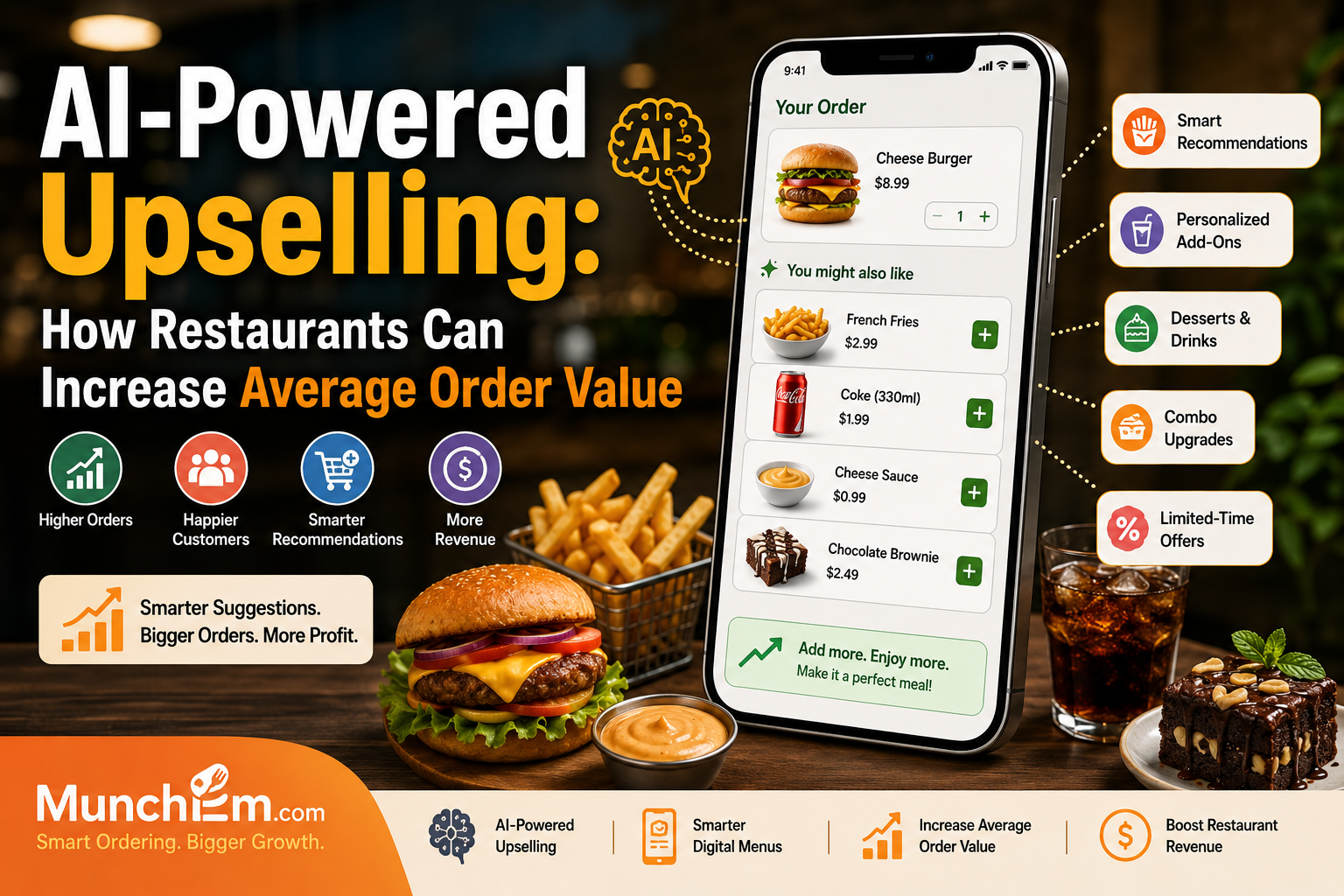
Restaurant owners are always looking for smarter ways to grow revenue without increasing labor costs, adding more seats, or spending heavily on advertising. One of the most effective ways to do that is by increasing average order value, often called AOV.
Average order value is simple: it is the average amount a customer spends per order. If a restaurant receives 100 orders and generates $3,000 in sales, the average order value is $30. If that same restaurant can increase the average order value to $36 without needing more customers, revenue grows immediately.
That is why restaurant upselling has always mattered. For decades, restaurants trained cashiers, servers, and phone staff to ask questions like:
“Would you like fries with that?”
“Do you want to make it a combo?”
“Would you like to add a drink?”
“Can I get you dessert today?”
Those questions still work, but they depend on staff remembering to ask at the right time. During rush hours, employees may be too busy. During phone orders, they may feel rushed. During online orders, there may be no human interaction at all.
This is where AI upselling changes the game.
AI-powered upselling helps restaurants recommend appetizers, drinks, desserts, premium toppings, combo upgrades, family meals, catering trays, and limited-time offers based on what each customer is ordering. Instead of showing every customer the same generic offer, AI can suggest the right add-on at the right time.
Restaurant technology is moving strongly toward personalization. Reports on restaurant technology trends note that AI-driven personalization is shifting from basic rule-based offers to machine-learning-driven recommendations, where menus and offers can reflect customer behavior and preferences. Major restaurant brands are also investing in AI and data platforms to improve operations, marketing, and personalized guest experiences.
For restaurant owners, this is not just a technology trend. It is a revenue growth opportunity.
With the right food ordering software, a restaurant’s digital menu can act like its best cashier: always available, never forgetting to suggest add-ons, and always focused on increasing the value of every order.
Why Average Order Value Matters
Average order value is one of the most important numbers in restaurant revenue growth.
Many restaurant owners focus on getting more customers. That is important, but attracting new customers can be expensive. Advertising, promotions, discounts, delivery marketplace visibility, social media marketing, and local campaigns all cost money.
Increasing average order value allows restaurants to grow revenue from the customers they already have.
For example, imagine a restaurant receives 300 online orders per week.
If the average order value is $25, weekly online revenue is: 300 orders x $25 = $7,500
If smart upselling increases the average order value to $30, weekly online revenue becomes: 300 orders x $30 = $9,000
That is an additional $1,500 per week.
Over a month, that could become about $6,000 in extra revenue. Over a year, it could become more than $70,000 in additional sales, depending on order volume and consistency.
The best part is that the restaurant did not need to add more tables, hire more staff, or spend more money acquiring customers. It simply made each order more valuable.
Average order value matters because it improves:
- Revenue per customer
- Profit potential
- Marketing return
- Online ordering performance
- Customer experience
- Menu profitability
- Repeat purchase value
For restaurants with digital ordering, average order value becomes even more important because the ordering journey can be designed intentionally. Every menu page, item detail page, modifier, combo suggestion, checkout screen, and confirmation page can influence what customers buy.
Traditional Upselling vs AI-Powered Upselling
Traditional upselling depends on people. AI-powered upselling depends on data, timing, and automation.
Both can be valuable, but they work very differently.
Traditional Restaurant Upselling
Traditional restaurant upselling usually happens through staff training. A cashier, server, or phone employee is trained to suggest add-ons.
For example:
- Make it a combo?
- Add cheese?
- Would you like a drink?
- Do you want our special dessert?
- Can I add garlic bread to that?
- Would you like to upgrade to a large?
This approach can work very well when staff are trained, confident, and consistent. But it has limitations.
During rush hours, staff may skip upselling to move faster. New employees may forget. Some employees may feel uncomfortable making suggestions. Phone staff may avoid extra questions because they want to finish the call quickly. Servers may miss dessert opportunities if the table seems ready to leave.
Traditional upselling also tends to be generic. Every customer may hear the same suggestion, even if it is not relevant to what they ordered.
AI-Powered Restaurant Upselling
AI-powered upselling uses digital ordering behavior, menu relationships, customer history, timing, and order context to recommend relevant add-ons automatically.
Instead of asking every customer the same question, AI can make smarter recommendations.
For example:
- A customer ordering a burger sees fries, a drink, and extra cheese.
- A customer ordering pizza sees wings, soda, ranch, and garlic knots.
- A customer ordering biryani sees samosas, raita, mango lassi, and gulab jamun.
- A family ordering multiple entrées sees a family meal bundle.
- A repeat customer sees items they ordered previously.
- A late-night customer sees quick-prep items or desserts.
- A lunch customer sees combo upgrades.
- A catering customer sees trays, beverages, and serving add-ons.
The difference is relevance.
AI upselling works best when the recommendation feels helpful, not pushy. The customer should feel like the digital menu understands what goes well with their order.
Examples of Smart Upsells
Smart upselling is not about randomly adding more items to the screen. It is about pairing the right product with the right customer decision.
Here are practical examples restaurants can use.
Burger + Fries + Drink
The classic fast-food upsell still works because it matches how customers already think.
When a customer orders a burger, the system can suggest:
- Fries
- Sweet potato fries
- Onion rings
- Fountain drink
- Milkshake
- Extra cheese
- Bacon
- Premium sauce
- Combo upgrade
A basic burger order may be $8.99. If the customer adds fries and a drink, the order may become $13.99 or more. If they add premium toppings, it may increase again.
The key is timing. The customer should see the upgrade immediately after selecting the burger or before checkout.
A good upsell message might say:
“Make it a meal with fries and a drink.”
Or:
“Customers often add crispy fries with this burger.”
This feels natural because the suggestion fits the order.
Pizza + Wings + Soda
Pizza restaurants have huge upselling potential because many customers order for groups.
When someone orders a large pizza, AI-powered food ordering software can suggest:
- Wings
- Garlic bread
- Breadsticks
- Soda
- Salad
- Extra cheese
- Premium toppings
- Dipping sauces
- Dessert pizza
- Family combo
A customer ordering one pizza may be feeding two or three people. A smart digital menu can recognize that and suggest group-friendly additions.
For example:
“Add 8-piece wings and a 2-liter soda to complete your pizza night.”
Or:
“Make it a family combo with wings, soda, and garlic bread.”
This is especially effective for Friday nights, sports events, parties, and family dinners.
Biryani + Appetizer + Dessert
Indian restaurants, Pakistani restaurants, and South Asian restaurants can benefit from AI upselling because many dishes naturally pair with sides, drinks, and desserts.
When a customer orders biryani, the system can suggest:
- Samosa
- Chicken 65
- Gobi Manchurian
- Raita
- Naan
- Mango lassi
- Masala chai
- Gulab jamun
- Ras malai
- Family biryani tray
- Weekend special combo
A biryani order may already be popular, but the restaurant can increase order value by recommending complementary items.
For example:
“Complete your biryani meal with raita and gulab jamun.”
Or:
“Add a mango lassi for the perfect pairing.”
AI can also help identify which add-ons convert best with each biryani type. Customers ordering chicken biryani may respond better to one appetizer, while customers ordering vegetarian biryani may prefer another.
Family Meal Bundles
Family meals are one of the best ways to increase average order value because they package multiple items into one attractive offer.
AI can recommend family bundles when it detects larger order behavior, such as:
- Multiple entrées
- Multiple quantities
- Evening ordering
- Weekend ordering
- Repeat family-size orders
- Catering-style behavior
Examples of family meal upsells include:
- 2 pizzas + wings + soda
- 4 burgers + fries + drinks
- Biryani family pack + appetizer + dessert
- Tacos + chips + salsa + drinks
- Pasta tray + salad + garlic bread
- Rice bowls + dumplings + drinks
Family bundles can work especially well for restaurants because they simplify the decision for customers. Instead of choosing many separate items, customers can select a complete meal.
A smart upsell might say:
“Feeding the family? Upgrade to a family bundle and save.”
Or:
“Add a family appetizer tray for everyone to share.”
The offer feels useful because it solves a real customer problem.
Appetizers, Drinks, Desserts, and Premium Toppings
AI-powered upselling can recommend different types of add-ons based on the order.
Appetizers
Appetizers work well when customers order entrées, group meals, or dinner items.
Examples:
- Mozzarella sticks
- Samosas
- Spring rolls
- Nachos
- Wings
- Garlic bread
- Loaded fries
- Chicken bites
Drinks
Drinks are high-frequency upsell items because they pair with almost every meal.
Examples:
- Fountain drinks
- Bottled drinks
- Iced tea
- Lemonade
- Mango lassi
- Coffee
- Smoothies
- Milkshakes
Desserts
Desserts are often forgotten in traditional ordering, especially for takeout. Digital menus can bring them back into the decision process.
Examples:
- Brownies
- Cheesecake
- Gulab jamun
- Ice cream
- Cookies
- Churros
- Tiramisu
- Dessert jars
Premium Toppings
Premium toppings are powerful because they increase revenue without creating an entirely separate order.
Examples:
- Extra cheese
- Avocado
- Bacon
- Paneer
- Grilled chicken
- Shrimp
- Mushrooms
- Jalapenos
- Specialty sauces
Limited-Time Offers
Limited-time offers create urgency.
Examples:
- Weekend biryani special
- Summer mango drink
- Holiday dessert tray
- Game-day wings combo
- Lunch-only combo
- Chef’s special appetizer
AI can help decide which customers are most likely to respond to these offers based on timing, order type, and past behavior.
How Personalization Improves Conversion
Personalization improves conversion because customers are more likely to accept suggestions that feel relevant.
A generic upsell says:
“Add dessert?”
A personalized upsell says:
“You ordered mango lassi last time. Add it again?”
A generic upsell says:
“Try our appetizer.”
A personalized upsell says:
“Add samosas with your biryani.”
A generic upsell says:
“Upgrade your order.”
A personalized upsell says:
“Make your chicken sandwich a combo with fries and lemonade.”
The more specific the recommendation, the more useful it feels.
Restaurant technology trends increasingly point toward personalization as a major growth area. AI-driven personalization can use past behavior, loyalty data, ordering history, and preferences to create more relevant menu recommendations. Dine Brands, the parent company of Applebee’s and IHOP, has also discussed AI-powered personalization that can analyze past purchases and similar customer behavior to recommend menu items and customized deals.
For restaurant owners, personalization does not have to mean complicated enterprise technology. Even simple personalization can help:
- Show popular add-ons for each item
- Recommend past favorites
- Suggest common pairings
- Promote time-based specials
- Highlight items similar customers order
- Offer bundles based on cart size
The goal is to make the menu feel smarter.
How AI Can Recommend Based on Past Orders
Past orders are one of the strongest signals for future purchases.
If a customer previously ordered chicken biryani with mango lassi, there is a good chance they may want that combination again. If a customer often adds extra cheese to pizza, the menu should make that option easy to select. If a customer orders family meals every Sunday, the restaurant can promote family bundles at the right time.
AI can use past order behavior to suggest:
- Order again
- Add your usual drink
- Customers like you also order
- Complete your meal
- Try this new item based on your favorites
- Upgrade to the bundle you ordered before
This is powerful because it reduces decision fatigue. Customers do not always want to browse the full menu. Many customers want to quickly reorder what they already like.
Past-order recommendations also support loyalty. When customers feel that a restaurant remembers their preferences, the experience feels more convenient.
For restaurants, this can improve:
- Repeat orders
- Average order value
- Customer satisfaction
- Digital ordering conversion
- Loyalty program performance
A smart ordering journey should not treat every customer like a first-time visitor. Returning customers should have a faster, more personalized path to purchase.
How Restaurants Can Promote High-Margin Items
Not all menu items are equally profitable.
Some items have high food costs. Others have better margins. Drinks, desserts, sauces, toppings, sides, and certain appetizers often provide strong upselling opportunities because they can raise ticket size without dramatically increasing kitchen complexity.
AI-powered upselling can help restaurants promote high-margin items more effectively.
For example, a restaurant may want to promote:
- Fountain drinks
- Specialty drinks
- Desserts
- Premium sauces
- Extra toppings
- Combo upgrades
- Appetizers
- Family bundles
- Catering trays
- Limited-time specials
Instead of discounting the main item, the restaurant can increase revenue by adding profitable extras.
This matters because revenue growth alone is not enough. Restaurants need profitable revenue growth. A restaurant could sell more low-margin items and still struggle. But if the ordering system encourages profitable add-ons, the business can improve both revenue and margin.
Examples:
A burger restaurant can promote premium toppings, fries, and drinks.
A pizza restaurant can promote wings, soda, dipping sauces, and dessert.
An Indian restaurant can promote appetizers, drinks, sweets, and family packs.
A café can promote pastries, flavored syrups, and larger sizes.
A hotel restaurant can promote beverages, desserts, breakfast pre-orders, and room-service bundles.
The best digital menu strategy combines customer relevance with business profitability.
Why Checkout Timing Matters
Upselling works best when it appears at the right time.
If the upsell appears too early, the customer may ignore it. If it appears too late, the customer may already be finished. If it appears too often, it may feel annoying.
The checkout stage is one of the most powerful moments for upselling because the customer has already decided to buy. At that point, they are reviewing the order and preparing to pay. A small, relevant suggestion can increase the order value without disrupting the experience.
Examples of checkout-stage upsells:
- Add a drink before checkout
- Complete your meal with fries
- Add dessert for later
- Make this a combo
- Add one more appetizer for the table
- Upgrade to a family bundle
- Add catering utensils and drinks
The checkout page should not overwhelm the customer with too many choices. It should show a small number of highly relevant recommendations.
A good rule is: fewer, better suggestions.
AI can help decide which suggestions are most likely to work based on item pairings, customer behavior, time of day, and order size.
For example:
A customer ordering one burger may see fries and a drink.
A customer ordering three pizzas may see wings and soda.
A customer ordering biryani may see raita and dessert.
A customer ordering a catering tray may see drinks, serving spoons, plates, and dessert trays.
The timing and context make the suggestion feel natural.
How Digital Menus Can Act Like Your Best Cashier
A great cashier knows how to sell without being pushy.
They understand the menu. They know what pairs well. They remember popular combos. They suggest upgrades clearly. They make customers feel helped, not pressured.
A smart digital menu can do the same thing at scale.
Digital menus can:
- Highlight best sellers
- Suggest add-ons
- Recommend combos
- Promote high-margin items
- Show limited-time offers
- Display popular pairings
- Remind customers about drinks
- Encourage dessert orders
- Offer family bundles
- Support repeat ordering
Unlike human staff, a digital menu does not forget. It can make suggestions consistently on every order, including online orders, QR code orders, mobile orders, takeout orders, hotel room orders, and catering orders.
This is especially important during rush hours. When staff are busy, upselling is often the first thing that gets skipped. A digital ordering system continues to recommend add-ons automatically.
For restaurant owners, this means the menu itself becomes a revenue tool.
Instead of being a static list of items, the menu becomes an active ordering journey that guides customers toward better meals and higher-value purchases.
AI Upselling for Different Restaurant Types
AI-powered upselling can work across many restaurant categories.
Quick-Service Restaurants
Quick-service restaurants can use AI upselling to promote combos, drinks, large sizes, sides, and limited-time offers.
Example:
A customer orders a crispy chicken sandwich. The system recommends fries, lemonade, and a combo upgrade.
Pizza Restaurants
Pizza restaurants can use AI upselling to promote wings, soda, extra toppings, dipping sauces, desserts, and party bundles.
Example:
A customer orders two large pizzas. The system recommends wings and a 2-liter soda.
Indian Restaurants
Indian restaurants can use AI upselling to promote appetizers, breads, drinks, desserts, family packs, and catering trays.
Example:
A customer orders biryani. The system recommends raita, samosa, mango lassi, and gulab jamun.
Cafés and Bakeries
Cafés can promote pastries, flavor upgrades, larger sizes, breakfast combos, and packaged items.
Example:
A customer orders coffee. The system recommends a croissant or muffin.
Hotel Restaurants
Hotel restaurants can use smart upselling for room service, breakfast orders, beverages, desserts, and guest service packages.
Example:
A guest orders dinner to their room. The system recommends dessert, bottled water, and breakfast pre-ordering.
Catering and Group Orders
Restaurants offering catering can increase order value with trays, drinks, utensils, desserts, and serving add-ons.
Example:
A customer orders a biryani tray. The system recommends appetizer trays, dessert trays, drinks, plates, and spoons.
How MunchEm.com Can Help Restaurants Create Smarter Ordering Journeys
MunchEm.com can help restaurants turn ordinary digital ordering into a smarter revenue growth engine.
Many restaurants already have menus online, but a simple online menu is not enough. A PDF menu or basic ordering page may show items, but it does not actively help customers build a larger order.
MunchEm.com can help restaurants create ordering journeys that are designed to increase average order value.
Smarter Digital Menus
Restaurants can organize menus in a way that helps customers find what they want and discover additional items. Categories, item descriptions, modifiers, add-ons, and images can all support better ordering decisions.
Add-On Recommendations
Restaurants can suggest appetizers, drinks, desserts, toppings, sides, sauces, and upgrades based on the customer’s order.
Combo and Bundle Promotions
MunchEm.com can help restaurants promote combos, meal deals, family bundles, and catering packages in a clear and attractive way.
Better Checkout Experience
The checkout page can be used to remind customers about relevant add-ons before they complete the order.
High-Margin Item Promotion
Restaurants can highlight profitable items such as drinks, desserts, sauces, toppings, and special add-ons.
Repeat Order Convenience
Returning customers can benefit from faster ordering and relevant suggestions based on previous behavior.
Practical for Local Restaurants
Restaurants do not need expensive enterprise software to start improving digital ordering. MunchEm.com is positioned as a practical platform for restaurants that want smarter ordering without unnecessary complexity.
Best Practices for AI-Powered Restaurant Upselling
To make AI upselling successful, restaurants should follow a few best practices.
Keep Suggestions Relevant
Do not show random items. Recommend products that naturally match the customer’s order.
Avoid Too Many Pop-Ups
Too many offers can annoy customers. Use clean, helpful suggestions.
Promote Items With Good Margins
Focus on items that improve profitability, not just revenue.
Use Clear Language
Simple phrases work best:
- Make it a combo
- Add a drink
- Complete your meal
- Popular with this item
- Add dessert
- Upgrade to family size
Test Different Offers
Restaurants should track which upsells perform best. Some items may convert better than others.
Use Photos When Helpful
Good images can increase interest in appetizers, desserts, drinks, and specials.
Keep Checkout Fast
Upselling should not slow down the order. The customer should be able to accept or skip quickly.
Final Thoughts: Turn Every Order Into a Larger Order
AI-powered upselling is one of the most practical ways restaurants can increase average order value and grow revenue.
It helps restaurants recommend the right item at the right time. It makes digital menus more intelligent. It helps customers discover appetizers, drinks, desserts, toppings, combos, family meals, catering trays, and limited-time offers that match what they are already ordering.
For restaurant owners focused on revenue growth, this is a major opportunity.
Traditional upselling depends on staff consistency. AI upselling works across every digital order. It can support online ordering, QR code ordering, mobile ordering, takeout, delivery, hotel room service, catering, and repeat customer journeys.
The result is a smarter ordering experience that benefits both the restaurant and the customer.
Customers get better recommendations. Restaurants get larger orders.
With MunchEm.com, restaurants can create smarter digital ordering journeys that help every menu visit become a stronger revenue opportunity.
Turn every order into a larger order with MunchEm.com.